Garage door opener not working: the checks to make, in order, before anyone comes out
Half the opener calls in the Austin area end with a reset, a battery or a flipped lock button, and we would rather you found that in five minutes than paid a trip charge for it. Here is the order to check things, what each result means, and the point where the right move is to put the ladder away and call.
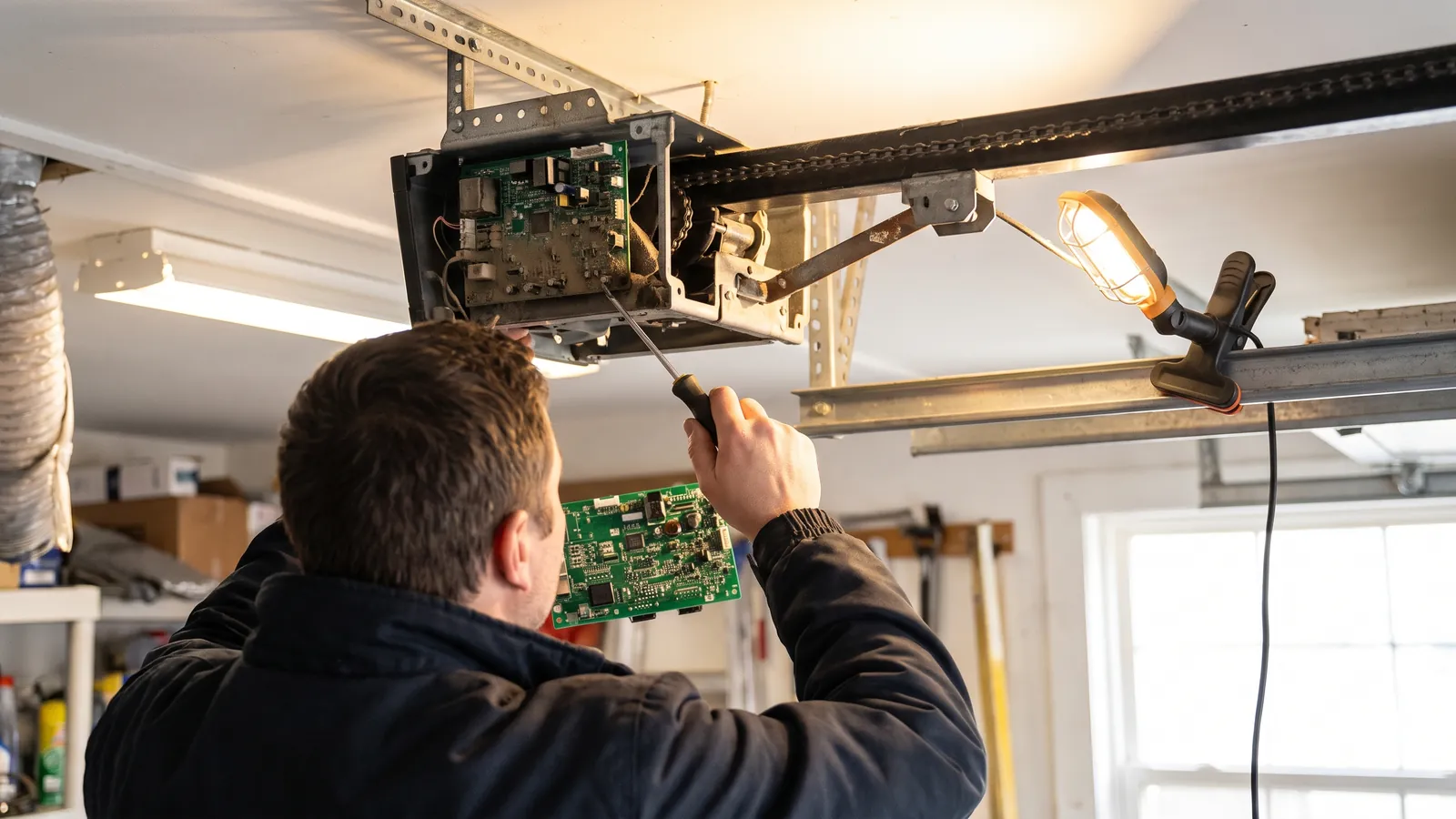
Work down this list from the top. Each step is safe to do yourself with the door down. If the door is stuck open, or you hear a bang and the door won't lift, skip the list and go to the last section.
Step by step
Is there power?
Look at the head unit on the ceiling. No light at all means no power. Check the outlet with a lamp, then the breaker panel for a tripped breaker, then any GFCI outlet in the garage or a nearby bathroom, because garage circuits often share one. Reset and try again.
Does the wall button work?
Press the button inside the garage. If the door moves, the opener is fine and the problem is the remote or the keypad. If nothing happens and the light is on, keep going.
Is lock mode on?
Most wall consoles have a lock or vacation button that disables all remotes. A blinking light on the console usually means it's on. Press and hold it for a few seconds until the light stops blinking, then try the remote. This one catches a lot of people after a vacation.
Remote battery
If the wall button works and the remote doesn't, change the remote's coin battery before anything else. If the remote has a light that doesn't come on when pressed, that's your answer. If a new battery doesn't help, the remote may need re-pairing; the manual or the learn button on the head unit does it in a minute.
The door starts, then reverses
Look at the photo-eye sensors near the floor on either side of the door. Each has a small light. One steady, one off or blinking means they're out of line or something is in the beam. Wipe the lenses, check for a leaf or a cobweb, nudge the bracket until both lights are steady. On a west-facing door, low winter sun can blind a sensor at a certain hour; a cardboard shade over the lens fixes it.
The motor runs but the door doesn't move
Look at the trolley on the rail. If it slides without taking the door, the release cord was pulled; close the door by hand and re-engage it, or run the opener until it clicks back in. If the trolley doesn't move and you hear grinding, the main gear has stripped. That's a repair, $160 to $360.
The lights blink a code
Count the blinks on the head unit's indicator. Manufacturers publish the codes: a common one is the sensor fault above, another is a travel or force fault, another is a board failure. Note the count for the technician; it saves diagnosis time.
Nothing after a storm
Lights off or dim, no response from anything, the day after a thunderstorm: a surge took the logic board. Check the breaker first, then stop. A board swap is $160 to $360 if the part is still made; on an older unit a new opener may be the better spend.
Where to stop
Stop and call if: the door made a loud bang and now feels like dead weight (that's the spring, not the opener); the door is crooked, or a cable is hanging; the opener grinds or smokes; the door is stuck open and you can't secure the house; or anything on this list needs you to touch the spring shaft, the cables or the drums. Those are the parts that hurt people. Everything above the shaft is fair game; nothing on it is.
What a technician does that you can't
Besides parts, the technician measures the door's balance with the opener disconnected. A door that creeps down when lifted to waist height has tired springs, and that's why the opener has been working too hard and why the gear stripped. Fixing the opener without fixing the balance is a repeat visit. The quote lists both and you decide.
The Austin pattern
Three failures account for most opener calls here. Surge-damaged boards cluster after the first line of thunderstorms in late spring and again in September. Stripped gears cluster in July and August, when a 115-degree garage thins the grease and the door gets cycled most. And sensor faults spike in December and January, when the sun sits low enough at four in the afternoon to shine straight into a west-facing door's photo-eye. If your failure fits one of those, you're in good company.
Questions this guide gets asked
The remote works from inside the garage but not from the street. Why?
Range loss. LED bulbs in the opener's light sockets are a known cause of interference; try an incandescent or an LED marked compatible with garage door openers. A failing remote battery also shortens range before it dies.
Can I just unplug the opener and plug it back in?
Yes, it's safe and sometimes clears a confused board. Wait thirty seconds. If the opener comes back but loses its limits, it will need re-setting, which is a short job.
The door closes a few inches and goes back up with no sensor light problem. What is it?
Usually the down-force or travel limit has drifted, or something is binding in the track. Check for a bent track section or a roller out of place. Don't keep forcing it; a door that binds is working its way toward coming off the track.
How old is too old to repair?
Around twelve to fifteen years, or any opener without photo-eye sensors regardless of age. Parts dry up, and a board that costs $300 on a unit worth less than that is a poor trade. The technician quotes repair and replacement side by side.
Is a humming opener dangerous?
Not dangerous, but it's a motor trying to move something it can't. Unplug it until someone looks; running it stripped burns the motor and adds to the bill.
Keep reading: Opener repair · Opener installation cost · Safety reverse test